Sheds for Narrow Side Yards, Slopes and Canyon Lots in San Diego: How Complete Shed Builds Where Trucks Can't Go
Tight side gate, sloped yard or canyon-rim lot? Here is how San Diego homeowners get a shed built on-site, and the permit, retaining wall, setback and Zone 0 wildfire rules that apply before Complete Shed's crew arrives.
Vanguard Merchants Editorial Team · November 25, 2026 · 9 min read · Updated November 25, 2026
Key takeaways
- Complete Shed builds on-site, so materials go through a side gate or up steps where a fully assembled delivered shed can't.
- Moderate slopes can be leveled with the treated wood base; steeper grades or drainage issues are reviewed and priced before scheduling.
- In the City of San Diego, a shed is permit-exempt at 120 sq ft of projected roof area, but steep-hillside (ESL) lots can lose that exemption.
- City retaining walls over 3 ft from the top of the footing need a permit; grading over 5 ft vertical generally needs a grading permit.
- In Very High Fire Hazard Severity Zones, keep a standard wood shed more than 5 ft from the house (Zone 0) and out of the 30-100 ft brush zone.
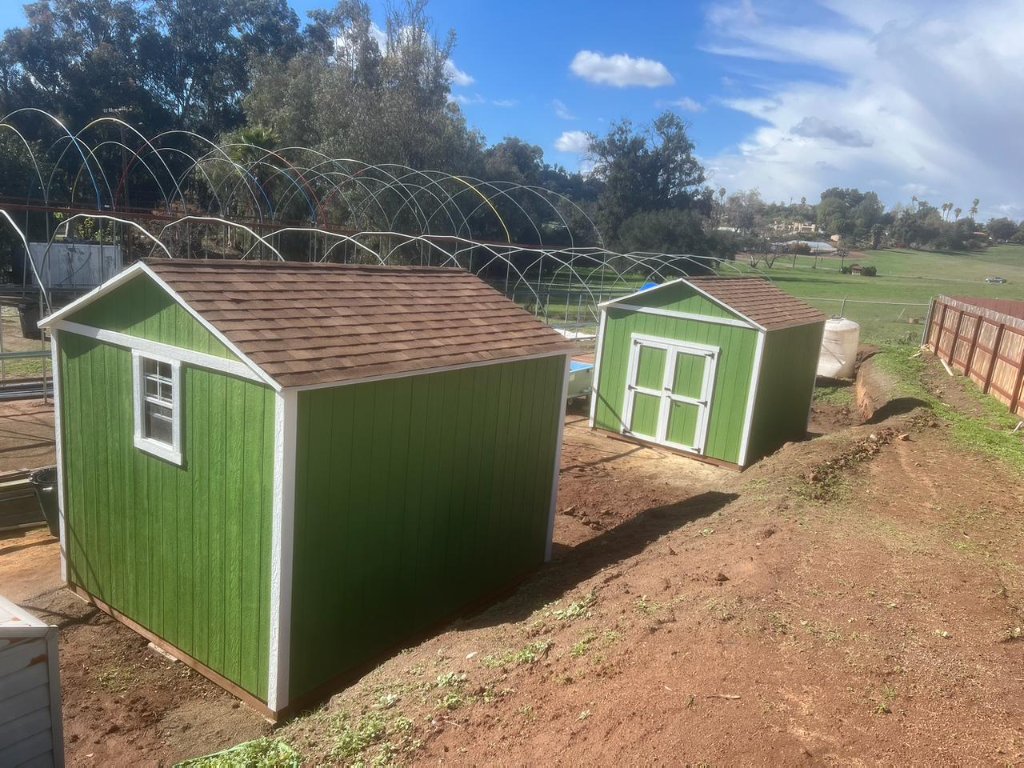
A shed delivered in one piece needs a clear path to the backyard, and many San Diego lots don't have one: the only way in is a narrow side yard, a set of steps or a slope that drops toward a canyon. Complete Shed builds its sheds on-site anywhere in San Diego County. The crew carries the materials in and frames the shed where it will stand. Before you build on a hillside or canyon-edge lot, check three things: the 120-square-foot permit exemption, the limits on retaining walls and grading, and California's new Zone 0 wildfire rules.
San Diego is a city of mesas cut by ravines. The San Diego Natural History Museum counts more than 150 canyons inside the county's urban areas. The City's Open Space Division manages about 3,000 acres of neighborhood canyonland, from Manzanita and Swan canyons in City Heights to Tecolote Canyon in Linda Vista and Rueda Canyon in Tierrasanta. For thousands of homeowners the backyard doesn't end at a fence. It ends at a drop.
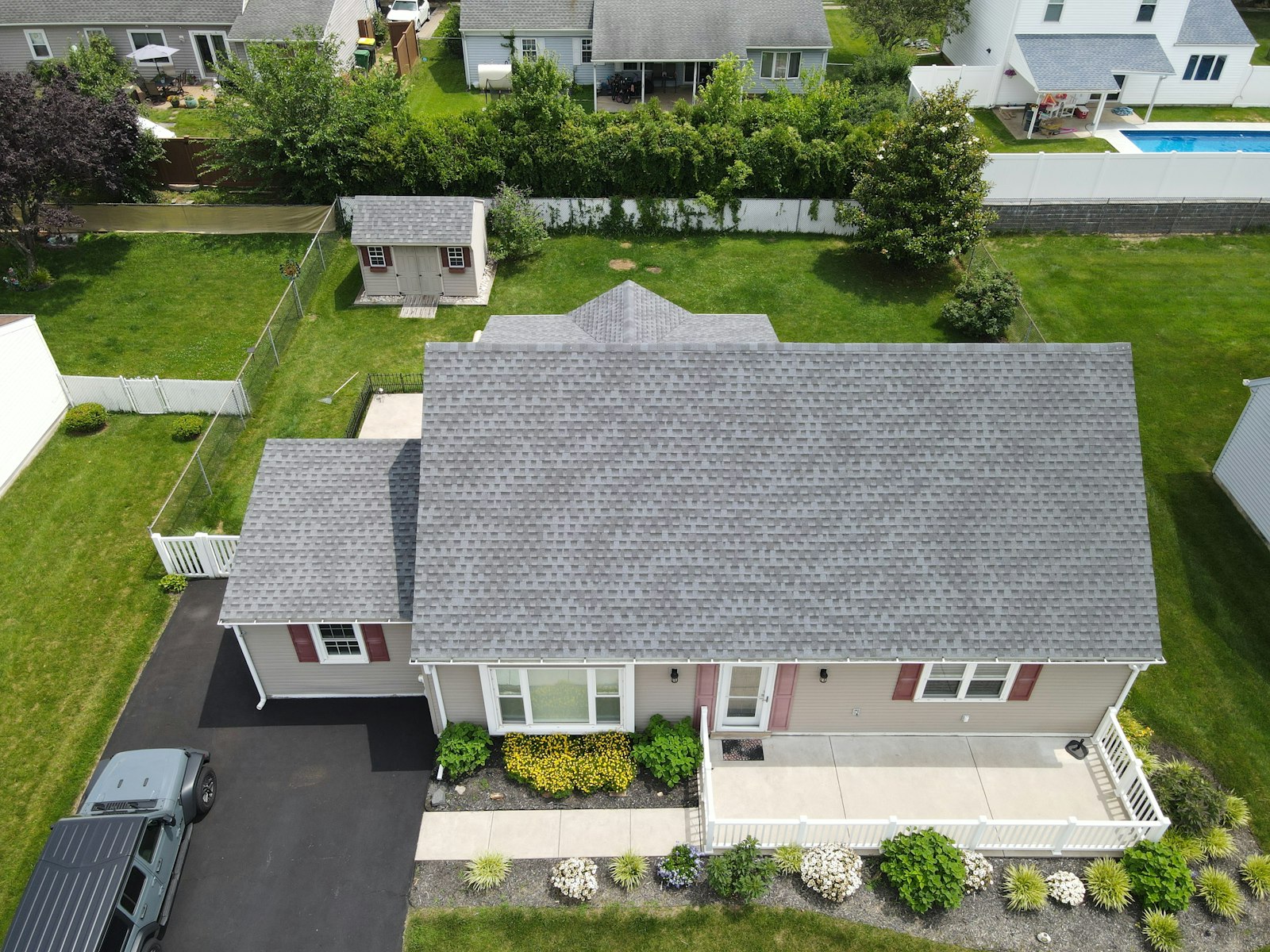
That geography makes an ordinary job difficult. A delivered shed arrives on a trailer, and a trailer can't climb garden steps, turn the corner of a side yard or back down a 20 percent grade. In older neighborhoods like Golden Hill, North Park and Normal Heights, the house often sits only a few feet from the lot line. The side yard ends up as a narrow passage with a gas meter, a water heater and a gate partway along.
This guide explains how San Diego homeowners in that position actually get a shed built. It covers which rules change on a slope or canyon lot and what Complete Shed, a builder based on 25th Street in the 92102 ZIP code, does differently.
Why is it so hard to get a shed into a San Diego backyard?
There are three common obstacles, and many lots have more than one.
- Access. A fully assembled shed has to pass through the narrowest point on its route. For many homes that point is a side gate or a gap between the house and a block wall.
- Grade. Canyon-rim and hillside lots in neighborhoods like Mission Hills, Kensington, Del Cerro and Mount Helix rarely offer a flat 8-by-10 pad.
- Wildfire rules. The City says about 142,571 acres, roughly two-thirds of its land, lies in a Very High Fire Hazard Severity Zone.
Complete Shed's installation page lists the sites it is set up for: narrow side yards, sloped lots, canyon properties, gated backyards, tight urban lots and sites with limited truck access.
How does an on-site build get past a narrow gate or a flight of stairs?
The shed arrives as lumber, sheet goods and roofing, all of which fit through a doorway. Complete Shed's FAQ explains that the crew builds the shed at the property instead of trailering in a finished structure. That avoids the access limits of delivery and lets the shed be positioned and finished in place.
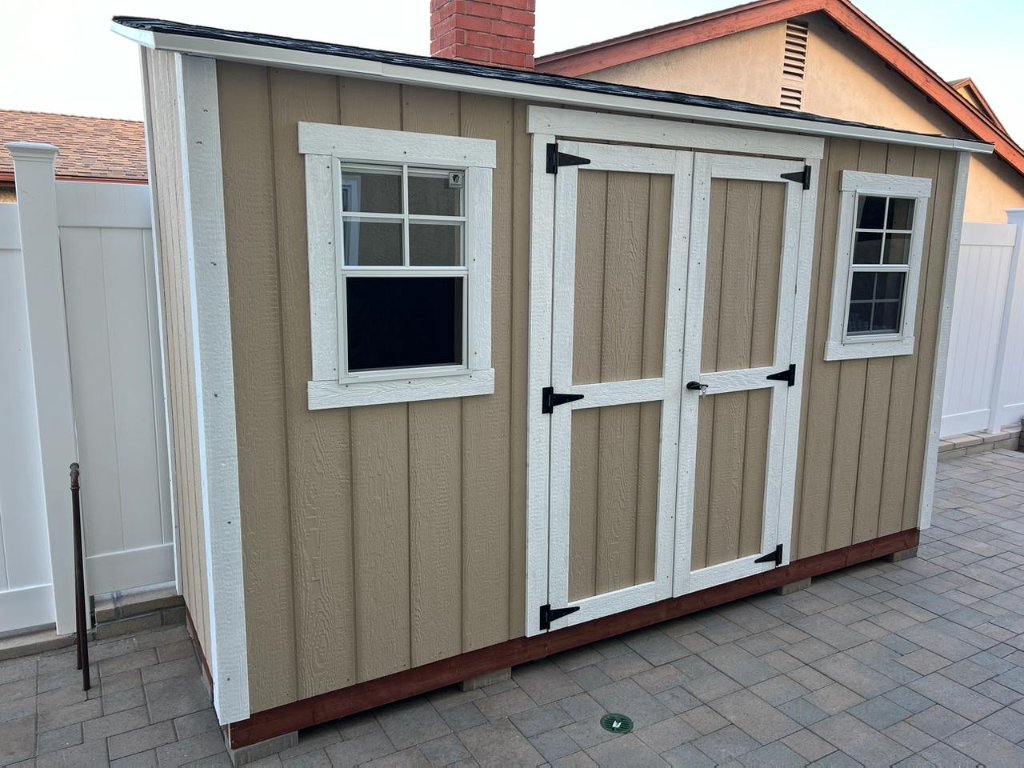
Every standard build starts from the same specification: a 2×6 pressure-treated wood base, a 3/4-inch tongue-and-groove plywood floor, LP Smart Siding walls, lockable doors and an architectural shingle roof. The base is leveled to the actual ground conditions, not to an assumed flat pad.
For long, skinny spaces, the configurator includes three lean-to footprints that are 4 feet deep:
- 4×8 lean-to: 32 sq ft, from $2,490
- 4×10 lean-to: 40 sq ft, from $2,690
- 4×12 lean-to: 48 sq ft, from $2,890
A lean-to has a single-slope roof and can run along a wall or fence, so it suits a side yard. Standard footprints go up to a 10×12 (120 sq ft, from $3,990). Larger or non-standard structures are reviewed one at a time, because size and height can change the permit requirements.
Can you build a shed on a sloped yard in San Diego?
Often, yes. Complete Shed says its on-site base can be leveled and supported on moderate slopes. Steeper grades or poor drainage may need more site preparation, which the company reviews and prices before it schedules the build. A concrete slab isn't required for a standard build. If you already have a slab or want one, mention it when you request a quote.
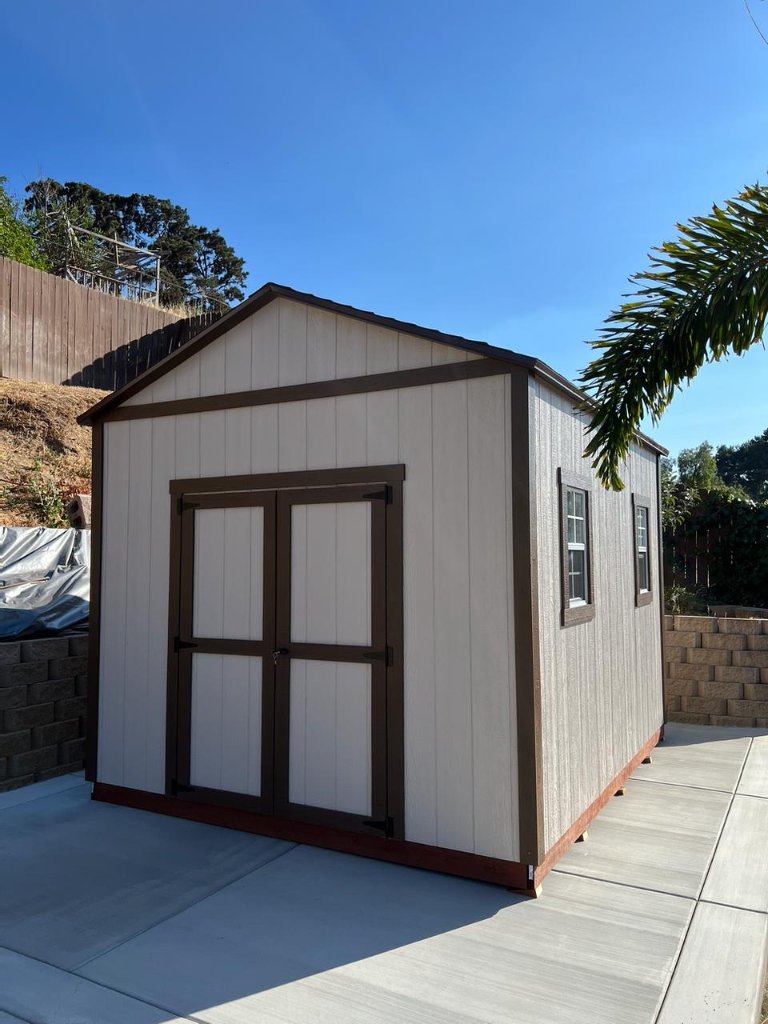
The harder question on a slope is usually the ground work around the shed, not the shed itself. The thresholds depend on where you live:
- Retaining walls, City of San Diego. A wall is exempt from a building permit only if it stands 3 feet or less from the top of the footing and doesn't hold back a surcharge such as a driveway or a slope above it (San Diego Municipal Code §129.0203). The state's model residential code allows 4 feet measured from the bottom of the footing, but inside City limits the stricter local rule applies.
- Retaining walls, unincorporated county (Spring Valley, for example). The County exempts a wall that holds back no more than 3 feet of soil, stands no more than 6 feet tall in total, has level backfill and has no other structure within 6 feet.
- Grading, City of San Diego. A grading permit is required for a cut or fill more than 5 feet deep, or one that creates a 25-percent-or-steeper slope more than 5 feet high. It is also required for work that changes drainage or concentrates runoff.
- Grading, unincorporated county. Work is exempt if it stays under 8 feet in vertical height and moves no more than 200 cubic yards.
For most pads, the practical takeaway is to step the site instead of carving a tall wall. Build the base up on the low side; don't dig a deep notch on the high side. Drainage needs extra thought in late fall and winter, when storms send runoff down San Diego's slopes. A shed base should never sit where it dams water against a wall or a neighbor's fence.
Does a shed need a permit on a hillside or canyon lot?
Usually not, if it's small. The details matter more on a hillside, though.
In the City of San Diego, a one-story detached accessory building is exempt when its projected roof area is 120 square feet or less. The City measures the roof, not the floor, so eaves count toward the limit. If a 10×12 footprint is your goal, ask how far the roof overhangs. Unincorporated county areas measure floor area instead, also with a 120-square-foot limit.
There's a less obvious catch. The City's exemptions don't apply when the property contains Environmentally Sensitive Lands and the work requires a development permit. Steep hillsides are one category of those lands. The City defines a steep hillside as a natural gradient of 25 percent with at least 50 feet of elevation change, or a 200 percent gradient with at least 10 feet of change. Canyon-rim lots are where you're most likely to meet this rule.
Two more points:
- The permit exemption covers the structure only. Running power to a shed still needs an electrical permit.
- Complete Shed helps with size, height and placement and points customers to the right jurisdiction. Its FAQ says permit applications remain the homeowner's job.
Carlsbad, Encinitas, Escondido, La Mesa and the county's other cities each run their own building departments, so check your own city's rules too.
How close to the property line can a shed sit in a narrow side yard?
In the City of San Diego, non-habitable accessory buildings can go in a required side or rear yard if every one of these is true (§131.0461):
- the lot is 10,000 square feet or smaller
- the building is no more than 15 feet tall and no more than 30 feet long within the setback
- it shares no wall with the house
- it has no more than 525 square feet of floor area
The City adopted these amendments in July 2026. In the Coastal Overlay Zone, which covers much of La Jolla, Point Loma and Ocean Beach, they don't apply until the California Coastal Commission certifies them. HOA rules can be stricter than any of this.
What do California's new Zone 0 wildfire rules mean for a shed near a canyon?
For canyon-edge homes, this is the newest rule and the one most likely to decide where the shed goes.
The City of San Diego divides defensible space into three bands measured out from a structure:
- Zone 0 (0–5 feet). The City's guidelines say outbuildings in this band must be built of noncombustible or ignition-resistant materials. Firewood, stored lumber and combustible fencing are restricted there.
- Zone 1 (5–30 feet). Low, fire-resistant plants, with tree canopies kept at least 10 feet from roofs and other structures.
- Zone 2 (30–100 feet). The City says structures and permanent irrigation aren't allowed in this thinned brush zone.
The City's Zone 0 guidelines say the rules applied to new structures on February 28, 2026, and apply to existing ones from February 28, 2027. Outbuildings may get a longer phase-in. At the state level, the Board of Forestry approved the Zone 0 regulations on August 19, 2026, and sent them to the Office of Administrative Law. Before you build, confirm the current dates with San Diego Fire-Rescue's Community Risk Reduction Division at (619) 533-4388. The City also offers a home wildfire risk assessment for $163.
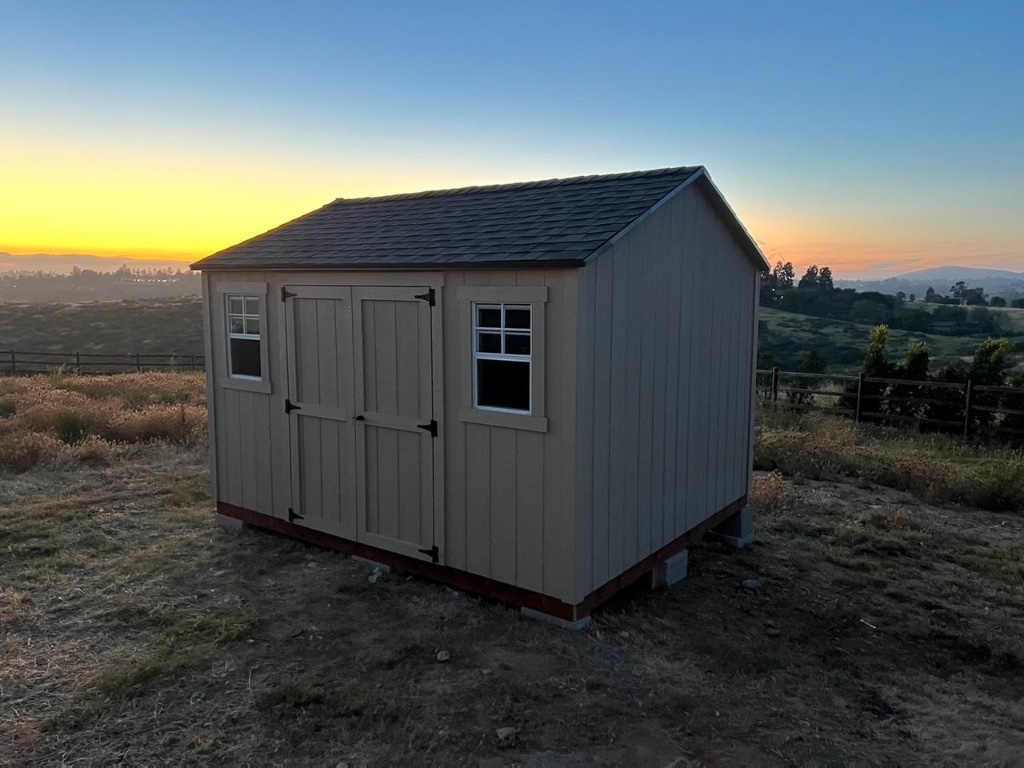
What this means in practice: a standard wood-framed shed with engineered-wood siding belongs more than 5 feet from the house and outside the 30-to-100-foot brush zone. On many canyon lots, that leaves Zone 1 as the obvious spot. Don't squeeze the shed against the back wall of the house or push it to the edge of the canyon. Treat the distance from the house as a design requirement from the start.
What should you measure before you ask for a quote?
Complete Shed's service-area page lists what it needs. Here is that list, expanded for difficult lots:
- Your city or ZIP code, which decides whether City, County or another city's rules apply.
- Photos of the whole route from the street to the site, including gate widths, steps, tight turns and overhead obstructions.
- The surface and slope where the shed will sit. Photos taken from the side show grade better than photos taken from above.
- The distance from the house to the proposed spot. On a fire-zone lot, more than 5 feet is the minimum to plan around.
- Room for the doors to swing, plus a clear working area around the footprint.
- Existing irrigation, plants or an old shed in the way. Complete Shed's site-prep guidance asks homeowners to clear or move these before the build.
Then ask the builder: How will you level the base on this grade? Does any part of the job need a retaining wall or fill? How far does the roof overhang? Who confirms the setbacks?
What does it cost to build a shed on a difficult lot?
The base price depends on the footprint: $2,490 to $3,990 for the eleven standard sizes. Upgrades are priced in Complete Shed's online configurator:
- 7-foot walls: +$495
- 8-foot walls: +$595
- Heavy-duty ramp for mowers and wheelbarrows: +$150
- 42-inch loft: +$200
- Old shed removal (demolition and disposal within 15 miles): $8 per square foot
On a hillside or canyon lot, the cost to watch is site-specific work: extra base support on steeper grades, drainage, and any wall or grading another contractor has to permit and build. Complete Shed says it reviews and prices extra site preparation before confirming the schedule, so get that number in writing up front.
Complete Shed at a glance
- What: Custom storage sheds, lean-tos, workshops and studios, chicken coops, playhouses and pet structures, all built on-site, plus assembly of qualifying store-bought shed kits (from $799)
- Where: San Diego County, including the City of San Diego; North County (Carlsbad, Encinitas, Escondido, Oceanside, Poway, San Marcos, Vista); East County (El Cajon, La Mesa, Lemon Grove, Santee, Spring Valley); and South Bay (Chula Vista, Imperial Beach, National City)
- Base pricing: $2,490–$3,990 for 4×8 to 10×12 footprints
- Founder: Sean Bashar Salem
- Phone: (619) 252-3894
- Email: completeshed@gmail.com
- Website: completeshed.com
Get a shed built where trucks can't go
If your yard has a tight side gate, a slope or a canyon view, a delivered shed may not be an option. An on-site build usually is. Send photos of your route and site, choose a footprint, and price it yourself in Complete Shed's online shed configurator. You can also read how the company handles shed installation on tight and sloped sites or call (619) 252-3894.
Frequently asked questions
Can Complete Shed build a shed if my backyard is only reachable through a narrow side gate?
Yes, that is the situation its on-site model is designed for. The crew carries materials to the site and builds the shed in place, so a fully assembled structure never has to fit through the gate. Share photos of the gate, steps and turns when you request a quote.
What is the best shed for a narrow side yard in San Diego?
A lean-to is the usual choice. Complete Shed's configurator offers 4×8, 4×10 and 4×12 lean-to footprints from $2,490 to $2,890, with a single-slope roof that can run along a wall or fence.
Can a shed be built on a sloped backyard?
Often, yes. Complete Shed levels and supports its treated wood base on moderate slopes. Steeper grades or poor drainage may require extra site preparation, which the company reviews and prices before scheduling.
Do I need a permit for a shed on a hillside lot in San Diego?
A one-story detached shed with 120 square feet or less of projected roof area is generally exempt in the City of San Diego, but the exemption does not apply where Environmentally Sensitive Lands such as steep hillsides require a development permit. Electrical work still needs its own permit.
When does a retaining wall for a shed pad need a permit?
In the City of San Diego, walls over 3 feet measured from the top of the footing, or walls supporting a surcharge, need a building permit. Unincorporated county areas have their own limits, and other cities set their own rules.
How far should a shed be from my house in a fire zone?
In the City of San Diego's Very High Fire Hazard Severity Zones, outbuildings within 5 feet of a structure (Zone 0) must be noncombustible or ignition-resistant, and structures are not allowed in the 30-100 foot brush management zone. Confirm current rules with San Diego Fire-Rescue.
Does Complete Shed pull permits?
Complete Shed helps plan size, height and placement and points customers to the correct jurisdiction, but permit applications and approvals remain the homeowner's responsibility.
How much does it cost to build a shed on a difficult lot?
Base prices run $2,490 to $3,990 for 4×8 to 10×12 footprints. Upgrades such as a heavy-duty ramp (+$150) and old shed removal ($8 per sq ft) are priced online; extra site preparation on steep or poorly drained sites is quoted before the build.
Sources
- Complete Shed: Shed Installation and Kit Assembly in San Diego County
- Complete Shed: San Diego Shed FAQ
- Complete Shed: Shed Configurator and Pricing
- Complete Shed: San Diego County Service Areas
- Complete Shed: About
- San Diego Municipal Code Ch. 12 Art. 9 Div. 2: Building Permit Exemptions (§129.0203)
- City of San Diego DSD: When Is a Permit Required?
- San Diego Municipal Code Ch. 12 Art. 9 Div. 6: Grading Permits (§129.0602)
- City of San Diego: Grading Permit
- San Diego Municipal Code Ch. 13 Art. 1 Div. 4: Accessory Buildings and Setback Encroachments (§131.0461)
- San Diego Municipal Code Ch. 14 Art. 3 Div. 1: Environmentally Sensitive Lands
- County of San Diego PDS 110: Building Permit Requirements
- County of San Diego: Grading Permit Application User Guide
- City of San Diego: Guide to Defensible Space for Property Owners
- City of San Diego Fire-Rescue: Zone 0 Guidelines for Existing Structures
- City of San Diego: State-Mandated Zone Zero Requirements Set to Go Into Effect
- Best Best & Krieger: Board of Forestry Adopts Emergency Zone 0 Regulations
- Times of San Diego: Homes Could Face New Wildfire-Safety Requirements Under Zone 0
- San Diego Natural History Museum: Urban Canyons
- San Diego Canyonlands: Canyon Enhancement Planning
- City of San Diego Parks & Recreation Fast Facts